Tuesday, November 27, 2012

WELCOME TO THE NEW DARK AGES CUTTING THE VISUAL ARTS IN TAFE


Remarks by Damien Minton at the SAVE TAFE ART
rally held at the Damien Minton Gallery 19 November 2012

To witness a living, breathing 120 year old institution like the Newcastle Art School being kneecapped by the O’Farrell government is a scandal.

This act of school yard bully boy violence is distressing as it has sent the dedicated art teachers, both full time and part time, into trauma as they scramble to salvage a new structure to stay alive in 2013.

The actions of this NSW government to stop funding the visual arts departments within the TAFE system from next year shows how we as a society has slipped back into a new cultural dark age. 

As one drives through or visits many regional towns in NSW there are still stately Victorian era buildings with the words ‘School of Arts’ sitting proudly on the façade.  They symbolise our 19th century great great grandfathers and mothers developing and maturing an understanding and resolve in placing the visual arts and crafts shoulder to shoulder with their work ethic of employment and business.

At the turn of the 19th into the 20th century there was real pride in using a visual language to inform, define and articulate community and society.

The O’Farrell decision to stop funding the visual arts within TAFE illustrates how far we have regressed from that proud stance.
We are back into the cultural dark ages, the neo age of despots, it is an act of Cromwellian proportions.

Macquarie Street has no understanding or knowledge as to how the visual arts in TAFE is an essential component of an economic eco system that circulates well beyond the art school walls.
The vast majority of artists this art gallery presents teach in the TAFE system, passing on their knowledge and skills for 8 to 10 hours a week.  Without it, their art practice becomes vulnerable and precarious.

Also, the first solo exhibitions by emerging artists staged at this gallery have invariably been recent graduates from TAFE.

The eagerness and enthusiasm of the artists’ families and friends is far more meaningful and infectious than the nickels and dimes that flow from the red dots on the white walls.

It gives young artists the confidence and possibility of being productive creative human beings.
The TAFE system provides a ‘hands on’ environment for creative people to be nurtured and encouraged, a ‘pastoral’ care model of teaching.

So to suddenly witness these ‘culture houses’ being destroyed is like watching a You Tube video of an Israeli missile slamming into its target.

The complicity of the TAFE bureaucracy to step aside and point at the soft target is cowardly and deplorable.

The art staff involved in this essential part of the broader visual arts industry now have to gasp for air in order to survive.  They are scrambling and stitching together a new fee structure for students in order to survive, all within four months.

You may ask yourself, why?
Cutting the funds of Fine Arts in TAFE compared to the enormity of NSW INC is hardly a cost saving measure.
It is the mosquito, not the elephant, in the room.
These gruesome and lethal cuts stem from the war the apparatchiks within TAFE have staged for decades.
It is a war against creativity, because creativity will never fit neatly into an economic determinist excel spreadsheet. The visual arts is irritating and the word culture immediately makes the eyes roll.
The bureaucracy’s obsession with quantitative data goes right up to the level of the Bacon and Kapoor shows currently on offer this summer.
Money spent in the visual arts can be justified if it fits into an economic strategy.
These people get turned on by balance sheets neatly adding up, they get orgasmic when red ink turns into a surplus.
So they fear creativity, even within themselves.  They don’t understand it, they don’t want this irritation.
So get rid of it.

Ironically this becomes the main weapon for artists and arts administrators.
It is something O’Farrell and his dark age Macquarie Street cronies fear the most … the joy and potency of creativity.

DAMIEN Minton
Director
Damien Minton Gallery
NOVEMBER 2012

Thursday, November 22, 2012

Bronwyn Barwell's opening address, 17 November 2012, Merchants of War: Tribute to Michael Callaghan


Thank you all for coming to Merchants of War. Especially thanks to the contributing artists and Damien Minton who has been pivotal to this show.

The focus of the exhibition is on the international corporations and middlemen – private and government, who foster and profit from the international trade in arms – from light weapons such as the iconic AK47 through to the new wave of technology driven weapons epitomised by the Drone.

These men and women in grey suits with neat suburban lives far removed from their victims are real perpetrators of war and the natural opponents of negotiated settlement.

War is fuelled by global economic imperatives. Countries far removed from the zone of conflict are profiting every minute of every day from the arms trade. Their victims grow exponentially.

Their blood money powers the growth of first world companies and economies.

This exhibition was borne from a commitment to community in the widest sense and fuelled by the anger at the sheer wrongness of a world where negotiated settlement is held to ransom by the merchants of war and frustration at the duplicity and inertia of our political leaders to come to the table on an Arms Trade Treaty.

Merchants of War is also about the more intimate community we inhabit as friends and colleagues who have come together to both pay tribute to Michael and his artistic and political legacy and in solidarity, to continue the tradition of politicised art practise.

This was to be Michael’s last exhibition – he had a number of works in progress. The night before he died, he said he didn’t know if he had enough strength to get the work done. My reply was all we can do is try and thanks to you all we have succeeded.

Michael’s practise was collective in nature.

The AK47 sculpture could not have been realised without:

         Greg McLachlan’s fine computer rendering in dissecting the connecting layers, OR
         Greg Page’s considerable carpentry skills in assembling the gun.
  
As Greg McLachlan commented, Michael always surrounded himself with artisans – the AK47 is as much a product of their skills as of Michael’s vision.

This exhibition in its entirety is testament to the power of collective practise.

On Michael’s behalf thank you and congratulations on a fine body of work.

Michael’s website is to be relaunched with the poster archive available for sale and viewing through the site. The profits from the sale and from this exhibition received by the estate will be held in a trust in Michael’s name and over time will hopefully, in a modest way, fund a travelling art scholarship amongst other things.

Tuesday, October 9, 2012

LOTTIE CONSALVO: STEER A STEADY SHIP

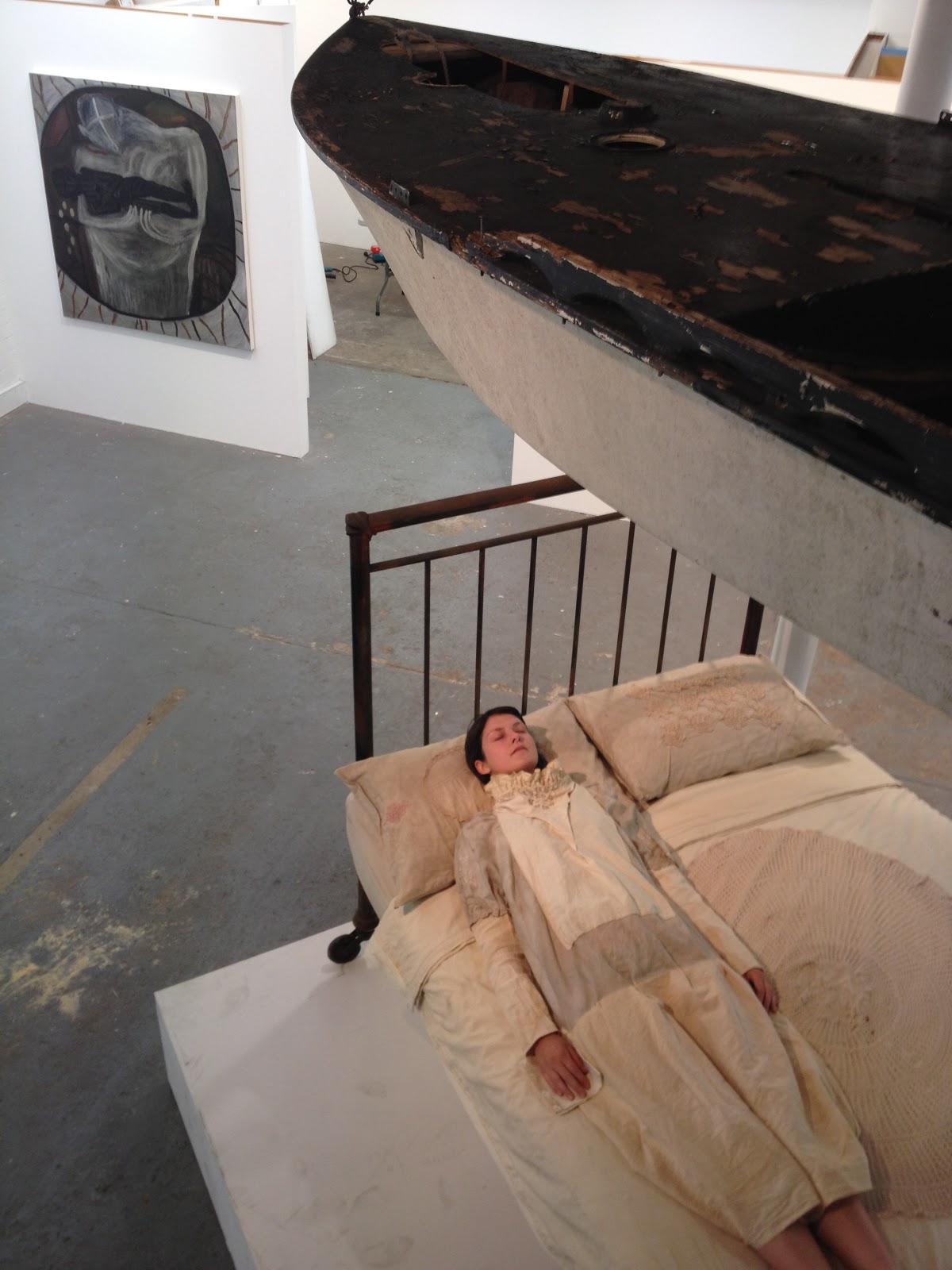
Last Saturday's performance by Lottie Consalvo, 'Steer a Steady Ship', has created a lot  of online media interest. Consalvo endured seven hours of consistent and persistent drops of black dye falling on her face. The international online visual art site, ArtInfo, had her on their front page. 

Our local Sydney Morning Herald ran a piece on the day and SBS World News Australia Online presented some coverage as well, read and see it here. 

This is what Lottie Consalvo was attempting to achieve with the performance:
“For seven hours I lay in a bed beneath the boat suspended in midair.  From the boat black liquid will drip upon my head. This is based on Chinese torture which can cause psychosis.

”This performance piece was conceived 12 months ago at a time when I was so consumed by anxiety that I could not sleep. I was scared of the thoughts that kept me awake. I feared my partner falling asleep before me. I would beg him to tell me stories of life in a sunroom by the sea to keep my mind afloat, sometimes this would work but mostly I would sink. When he would fall off to sleep it was just me and my mind, I felt completely alone. 'Steer a steady ship' was a line I heard a lot growing up, it meant, hold yourself together and stay focused. At this time I felt like I couldn't hold it together, the ship hung heavy above me, I had no control. Bedtime was a time of absolute torture. I couldn't stop my mind.
 
“I think this experience is shared by many. The days and nights of struggle living with anxiety and depression.”

This performance was part of Lottie's current exhibition, The Life Exchange, and its aftermath creates an eerie echo of the work on the walls, which can be viewed here.

Exhibition dates: 3 - 20 October 2012

Thursday, September 6, 2012

Toby Zoates in the Annex Space

Happy New Year, 1978, acrylic on paper, 560 x 380 mm

We are humbled and excited to have a slice of history from the Sydney underground in our Annex Space with Toby Zoates' exhibition Regurgitated, Posters + Paintings 1978-2012. For anyone who missed it, the Sydney Morning Herald ran this candid article on punk-activist-street artist Toby Zoates in the Spectrum 1/9/2012. 

Come along to the opening 
TUESDAY 11 SEPTEMBER 2012
6-8 PM
583 Elizabeth, St Redfern

Don't miss Toby Zoates performing:
'The Artist's Sob Story' on
SATYRDAY 22 SEPTEMBER
3PM
with original music by Peter Urquhart

Exhibition dates 11-29 September 2012

Thursday, August 23, 2012

Ross Laurie - New Paintings and Works on Paper 2012 catalogue essay


Ross Laurie, Near the bridge III, 2012, oil on Board, 400 x 510 mm

For the Ross Laurie exhibition, New Paintings and Works on Paper 2012, we commissioned journalist and writer James Compton to contribute this essay:

"In the electric action of Ross Laurie’s painting you can see the marks of progress. These steps are important to the artist in documenting the creative journey, while also giving the wider audience clues to the structure and sequence behind the total view. Laurie likes to examine, or read, a painting – whether one of his own making or that of another painter. He looks closely at the combination of gesture, abrasion, colour, form and flow. Through the textures of the paint’s physical application, the artwork becomes a landscape in itself. These contours have to hang together in a composite tension, or it simply isn’t working.

Laurie sits outside the mainstream. A whitefella painter schooled in the European tradition, yet intensely drawn to the lexicon of indigenous artists, particularly the desert painters, that has emerged from Australia into the global consciousness since the 1970s. In this context, he is a vital representative of Australian art’s contemporary collision between old and new – and it is fair to say that many see the close affinity with indigenous painting in some of Laurie’s works before they get fixated by any abstraction. He takes on, whether subconsciously or overtly, the exploration of where the DNA of an ancient but very much alive Aboriginal culture recombines with a transplanted Western art sensibility. 

He is not afraid to acknowledge his antecedents.  Laurie’s painting is clearly informed by the great leaps made in the 1940s and 50s through the abstract expressionism of De Kooning and Pollock, while not ignoring their Australian contemporaries such as Tony Tuckson and Ian Fairweather.  This era of experimentation is the starting point, a lineage and context to which Laurie often returns; in essence he is competing with himself to produce something he would value as much as a great work done by one of his artistic influences. He calls himself an ‘old artist’, but what he is forging should be regarded as an emergent push into new territory, boldly venturing further into the unknown.

From his bush-bound isolation on the New England plateau, he often buries himself in art tomes, absorbing ideas, spaces, and experiences that will be turned into riffs played out on canvas, paper or board in the studio. He paints from the inside out, and the outside in: landscapes as much of the soul as of the physical reality that makes up the country around him. His output resonates with an often brutal honesty; rather than a precise delineation, it is nomadic, cycling through fertile ground in a meandering songline. As abstract as they may appear at first blush, Laurie’s works are ultimately rooted in the trees, the hills, the clouds and the quality of light that makes up his milieu.

A single work might involve a stretch of 7-8 hours until he is finished, content that the act has reached some sort of resolution. Picture the crucible of creation: it is a cold winter’s night, wind scouring from the south-west, rain sleeting across the corrugated iron roof. A rusted pot belly stove gives off a good heat, chock full of brushbox and ironbark harvested from deadfall around the studio, warm enough to take the chill out of the air but not quite enough to melt the oilstick debris piled up around the workbench. His collection of CDs lies scattered, a range of aural cues ready to assist in shutting out the chattering of conscious thought and loose forth his own dreamtime.

The studio resounds to a newly found live recording of Miles Davis in his prime of electric experimentation, trumpet at full blow as he gets his Bitches Brew band into the groove. A kettle steams in the foreground, seemingly on continuous reboil as the session unfolds. Fuelled by endless cups of tea, straight black (no chaser), Laurie flares into action as he attacks the canvas. He deftly manipulates brush and paint, a trance-like series of movements focused on capturing that definitive pulse of inspiration. It is an outpouring, a process of envisioning  that persists into the wee hours, striving to keep up the momentum as he backs himself from one step to the next, wary of too much of a pause lest he interrupt that precariously dancing muse.

Each painting is wrought from elements intermingled in that particular time and space. He feels the subject matter through a series of filters, devising colour combinations that make the works sing in a way that expresses his unique feel for the expanses in front of (and behind) his eyes. Random routines are introduced into the process as he tries to break the mould. If he reaches a blockage, he might rotate the canvas through 180 degrees, or paint with eyes wide shut, in order to see new permutations within a complex algebra. His urgency is driven by trepidation that if he stops, he might not be able to get back ‘out there’ again into the same headspace. At the same time, he is not scared to scrape back and start again if a particular passage is not working. It is a wild ride, holding on bare-knuckled until the right combination reveals itself and points the direction of the painting.

This collection – in its synthesis of oils, oilstick on paper and charcoal drawings – is one of consolidation. Ross Laurie has taken his technique, his composition, his style to a new place.  He articulates his experience in a conglomerate tongue that takes some time to get your head around. Not that it is impossible but perhaps it is beyond rational thought. It is fundamentally spiritual, and therefore difficult to articulate. There is an emotional resonance from each of these works that speaks to your inner being and asks: ‘do you feel me’?

The works are also inspired, much like his passionate verbal discourse, by a quest to cut through the mundane and extract a kernel of truth. There is no deliberately grand theme, save that of a further investigation of the human condition. With every completed work comes a new discovery, and as Laurie says upon reflection: “I can then look back and find out what I was doing, and that knowledge enables me to move on.” 

James Compton, August, 2012


New Paintings + Works on Paper 2012
Tuesday 4th - Saturday 29th September, 2012
Wednesday - Saturday, 11-6

View a selection of the work here

Tuesday, August 21, 2012

Elaine Campaner selected as a finalist in the Bowness Photography Prize - for the second year running

Landscape with camels, 2011, pigment ink-jet print, 93 x 140 cm
from the series Of Middle Eastern appearance (the visual guide)

We would like to congratulate Elaine Campaner for being selected in the 2012 Bowness Photography Prize with the above image, Landscape with Camels, from the series Of Middle Eastern appearance (the visual guide). This is a commendable achievement particularly considering that of almost 2500 photographs submitted by 495 entrants, only 42 were selected. This is the second year that Elaine's work will be hung as a finalist. You can see the 42 finalists here.

The William and Winifred Bowness Prize was established to promote excellence in photography, showcasing some of the most outstanding contemporary work produced in Australia over the past 12 months. This year Elaine will be exhibited alongside the likes of Julie Rrap, William Yang, Tim Johnson, Stephen Dupont and many other esteemed Australian artists.

Wednesday, August 8, 2012

Jon Frum Art Foundation 2020 On Again

Damien Minton Gallery welcomes back '2020' to the Annex Space, and this year it is 20 art shows over 10 days, curated by Jon Frum Art Foundation and Robert Lake. 
15-24 August, 2012.

'Science Fictions' 2011- Connie Anthes and Dr Julian Berengut, who will appear in 'Method in Madness', Thursday 23rd August
Last year the Jon Frum Art Foundation attracted much interest and attention with this curatorial model that sees short sharp exhibitions as one-night-only events. 

We are pleased to note that many of the young artists presented in last year's '2020' have since attracted interest and attention from galleries in Sydney and in terms of funding and residencies. In 2012 Curators Jon Frum Art Foundation and Robert Lake will split the space and have one show each over 10 days. Full program below.


It's hard to pick favourites, but we recommend:

All shows are on at the Damien Minton Gallery Annex Space. 583 Elizabeth St, Redfern.